Showing posts with label economy. Show all posts

Thursday, November 6, 2014

My thoughts on why Spotify is flawed

+PCMag states it best: "Good music that people enjoy has to be worth something."

That's the precise problem with Spotify—it is probably the only music product on the market today that offers an on-demand music library, free-of-charge.

Many have compared Spotify to other streaming services, such as +Pandora. The problem is, by definition, Pandora and Internet radio, designed specifically for discovery, and subscription services, like +Beats Music and +Google Play Music All Access, are based on completely different models. Internet radio provides limited ability to play the exact track on-demand and subscription services are obviously paid services. 

Spotify has created users who feel entitled to virtually owning and playing specific music at no charge. For example, I have seen comments, from Spotify users, asserting that Taylor Swift should have her music on Spotify because not everyone has the financial ability to purchase it or how costly it would be to pay for music. I'm not sure when we evolved into a society where content, and other peoples' works, that took valuable skills and insane amounts of time to create, were taken for granted. Or, as +The Telegraph puts it, "we now have an extremely entitled culture, where any kind of art is seen as a communal property." Certainly, not everyone can afford books, movies and even Android devices or iPhones, all various types of content and products that hard-working people create and turn into reality.

In an interview with Yahoo!, Taylor summed up how she felt when she tried releasing new music (Shake It Off) directly on Spotify: 
I felt like I was saying to my fans, "If you create music someday, if you create a painting someday, someone can just walk into a museum, take it off the wall, rip off a corner off it, and it's theirs now and they don't have to pay for it." I didn't like the perception that it was putting forth (Taylor Swift).  
Taylor Swift performing in Arizona during her RED World Tour.
I have always believed that the Internet should be free and open and that we should create better marketplaces and channels for content to be accessed and distributed at reasonable prices. This should be decided by the equilibrium of supply and demand. This is our best bet against piracy, not distributing content for free or keeping it in exclusive, far-to-reach corners of the web.

A lot of people, especially those that I have had a pleasure of discussing this issue with, believe Taylor is being greedy or selfish. I disagree. She is continually adding to the next generation of the music industry and trying to solve some of the biggest problems it has ever faced. She is standing up for superstars and indie-bands alike, because her position allows her to. It's why various smaller artists have tweeted her, praising her stance against Spotify, calling it "a streaming service that doesn't pay."

Payment in exchange for creative and valuable content is simply so that those same content creators creating all the things we enjoy can continue to innovate and bring us even more quality content. It's the same reason why big-name artists, including Adele, +Coldplay+BeyoncĂ© and others, have followed the approach of releasing Spotify versions months after their music actually comes out. Unfortunately, smaller artists don't have the ability because they first need their music just out there however and wherever it can be—it's time they should start making money too.

In fact, according to PCMag, 
Swift wanted to keep her latest album on delayed-release, or at least only available to Spotify's premium subscribers, which Spotify didn't want; hence the impasse.
I am not saying that streaming services aren't the answer. But, I do not think Spotify and its flawed model, in particular, are the answers we are looking for, both as consumers and content creators—we will get lower quality of content and content creators cannot make a living. The music industry is ripe for innovation, but Spotify does not have the solution.

At the end of the day, Taylor Swift ignited an important conversation about how much we value content and everyone should be happy about that.


Additional Articles
"Taylor Swift vs. Spotify: Why Music Should Not Be Free"

"Taylor Swift Shuns 'Grand Experiment' of Streaming Music"

"Taylor Swift left Spotify because we stopped valuing art"

Sunday, September 28, 2014

I LOVE HK: a spark for democracy

I LOVE HK.

My beautiful birthplace, Summer 2013.
There's a quote most often attributed to Thomas Jefferson that says: "When the people fear the government, there is tyranny. When governments fear the people, there is liberty."

And then, in "The Hunger Games," there's a quote that reads: "Every revolution begins with a spark."

I genuinely believe in these two profound quotes. And that's why today, my thoughts are with the brave peoples of Hong Kong, from students to working professionals, standing up for something they believe in and fighting for a universal right, namely universal suffrage, that we, as humans, should each have. I stand with you. I feel your pain and suffering. 

I say peoples, and not people, of Hong Kong because it's a diverse city comprised of so many backgrounds, beliefs, national and ethnic origins, race, religions and sexualities, all of whom are united to defend the freedom that Hong Kong has enjoyed over the past decades. It is precisely this freedom that has allowed Hong Kong to become a cultural, economic and political beacon in the East to so many.
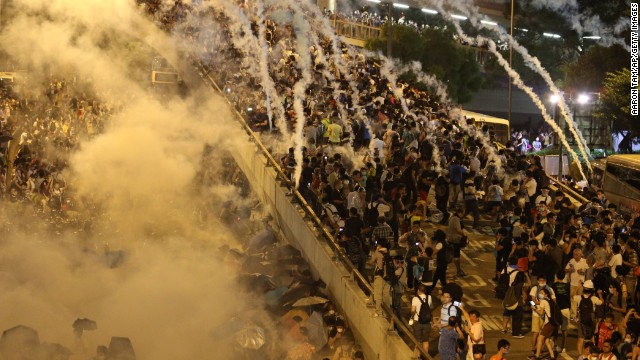
Hong Kong today, September 28, 2014. Courtesy: CNN.
Governments like China cannot endure, at least not in their current form, especially in this new digital age. And a simple spark can lead to something revolutionary. The way governments work is a new game for this next century—people can demand their voices to be heard, more so than ever before and I believe what is right will prevail. Hong Kong has been so prosperous because of the equality and freedom—freedom of assembly, of expression, of information, of the press, of speech—that has existed over the past several decades. I don't think there is anywhere as prepared as Hong Kong to remind us that freedom is truly not free and must be defended daily.

My heart hurts and I am saddened seeing the devastating photos come out of Hong Kong, photos of streets that I have walked on and admired. But it also makes me proud of the citizens of Hong Kong. In Hong Kong, just like as in American cities, these shouldn't be seen as embarrassments, but rather, a functioning civil society able to hold thoughtful conversations and stand up for what they believe in. The government is the entity that should be embarrassed for their oppressive response and for governing without the consent of the governed.

That's why I also think, for me, I find stories like "The Hunger Games" so powerful, because people are living out these scenarios each and every day. It's quite inspirational if you think about it.

Night lights in Hong Kong, Summer 2013.

"Echoing Tiananmen, 17-year-old Hong Kong student prepares for democracy battle"
CNN and CNN International
—"Fear has been deeply rooted in our genes through the past 65 years. The majority of China's 1.3 billion people are not true citizens; most of the people are simply submissive."
—"You can form political parties in Hong Kong. You can publish books that are forbidden in mainland China. The media can criticize the central government and the chief executive of Hong Kong."
—"Mainland China is a tinderbox that's been physically suppressed by the authorities, and Hong Kong is a seed of fire."
—"The Communist Party is very scared of this tiny bit of land, because if true universal suffrage can blossom in Hong Kong, it is very likely true universal suffrage will end up happening in the mainland."

Monday, October 21, 2013

Economics discounts the innate good in people

"The fact that you possess a sense of morality, and we do not, gives us an evolutionary advantage..."
-Man of Steel
Or does it?

Is there something bigger we want to reach for or is self-interest our basic resting pulse? 
-The Newsroom

After my Microeconomics class today, this article ("Does Studying Economics Breed Greed?"by Adam Grant) popped up on my +LinkedIn feed. The article cited studies that showed how Economics was creating students with less values and more greed. Very appropriate. And I completely agree. As interesting as Economics is, I was telling my mom earlier this school year why I think it is fundamentally flawed.

Economics virtually asserts self-interest is 100% responsible for explaining how humans act. And it promotes that sense -- that our world is better when we focus on self-interest and maximizing our own utility. It states that this allows society to be more efficient and have more of everything and more is better. In fact, throughout the years, I have been told that Economics can happen because of "greed," and that it actually makes us all better off.
Courtesy: http://blog.tifwe.org/c-s-lewis-greed-and-self-interest/
But I'd like to think that the world doesn't work that way. That there's innate good in each individual. That we can have maximized efficiency while also being moral.

I was also telling my mom the other day that society's focus on economics, the economy, pure dollar signs and percentages, instead of over morals and values, is the exact reason our world economy is where it is today. The reason that 2008, and everything afterwards, happened.

In sports, you can't win a game by merely focusing on "winning." Likewise, you can't fix the economy by only caring about the numbers. In both, it's about the underlying values, whether it's the fundamental skills and teamwork or the sense of instilling morality.

It isn't a greed-less world that we are striving for. Or even one where everyone receives the same resources. Instead, it is one where we can harness greed to truly make the world a better place. It's one where competition, cooperation, ethics, morals and openness are all promoted.

Because we don't want to end up like the people of Krypton.

Thursday, May 31, 2012

The issue with banning drinks

Recently, New York City has announced that it may ban large, sugary drinks, specifically those over 16 ounces, from being sold, in an effort to try to keep its citizens healthy.

It's utterly disturbing. It's economically and morally wrong. It's plainly not right. America has always been the land of the free - where companies can flourish and citizens can make their own informed decisions. Implementing a ban on such products will ultimately restrict both of those freedoms.


Image Courtesy of McDonald's
http://www.mcarkansas.com/26966/20992/default-page/

The Economy
Operating a business is already hard enough, and it's getting harder and harder each day in America. Piling on more restrictions on what businesses can or cannot do restricts their mobility and, in turn, devastates the economy. When Coca-Cola, Pepsi, McDonald's or other successful American businesses have to stop selling drinks larger than a certain size, that's cutting off profits that they otherwise would have had. And, if they want to try to balance out the losses, prices on other products may rise, hurting American consumers in the long-term.

Imposing new regulations on businesses drives up the cost of doing business, and that's not something we want, especially during a economic recession that's still taking place today. 

But, more importantly, a ban of this sort is immoral, and something that is in complete contradiction with the morals this great country of freedom was founded upon.

The Morality
America was founded as a country where its citizens could make individual choices based on their own judgements, knowledge and morals. What and how much a specific citizen chooses to drink, and what he or she wants to do to the body falls under the list of individual choices and decisions, and is one that the government has no right to decide.

Furthermore, unlike alcohol, drinking too much sugary drinks only hurts the individual in the long-run, and will not cause the individual to act with poor judgement. America has always stood for tolerating other people's actions and opinions, as long as it does not hurt surrounding citizens. This is the same thing.

The government (along with scientists and the  mainstream media) has continuously warned about the dangers and risks of drinking drinks with an excess of sugar. That's the farthest the government should go and that has always been their role regarding how they protect citizens. Is the government going to start banning syrup, bacon, coffee and other "unhealthy" foods as well? Who's to decide what is unhealthy or not? Let individuals decide this for themselves based on the known facts and studies.

Finally, banning large, sugary drinks is "censorship" on a physical level. The government cannot and should not assume what those drinks are used for after being purchased. In this case, they are assuming that it will be used for consumption, individually. Maybe it will be split up between a family. Maybe between a few friends. Whatever the case, the government cannot assume anything. Even if it is for the individual, there are too many motives to just have a general ban on these products.


Beverage companies and restaurants already have an obligation to clearly display nutritional information on each and every packaging label. Calorie counts, sugar amounts and more are already made readily available for each consumer. From that point out, it's up to the consumer to judge whether it is right or wrong, good or bad, for them to purchase and consume. Just like how prohibition did not work in the 1900s, banning large and sugary drinks will not work either. But this time, there's a lot more moral issues involved that would threaten the freedom Americans have come to enjoy daily.